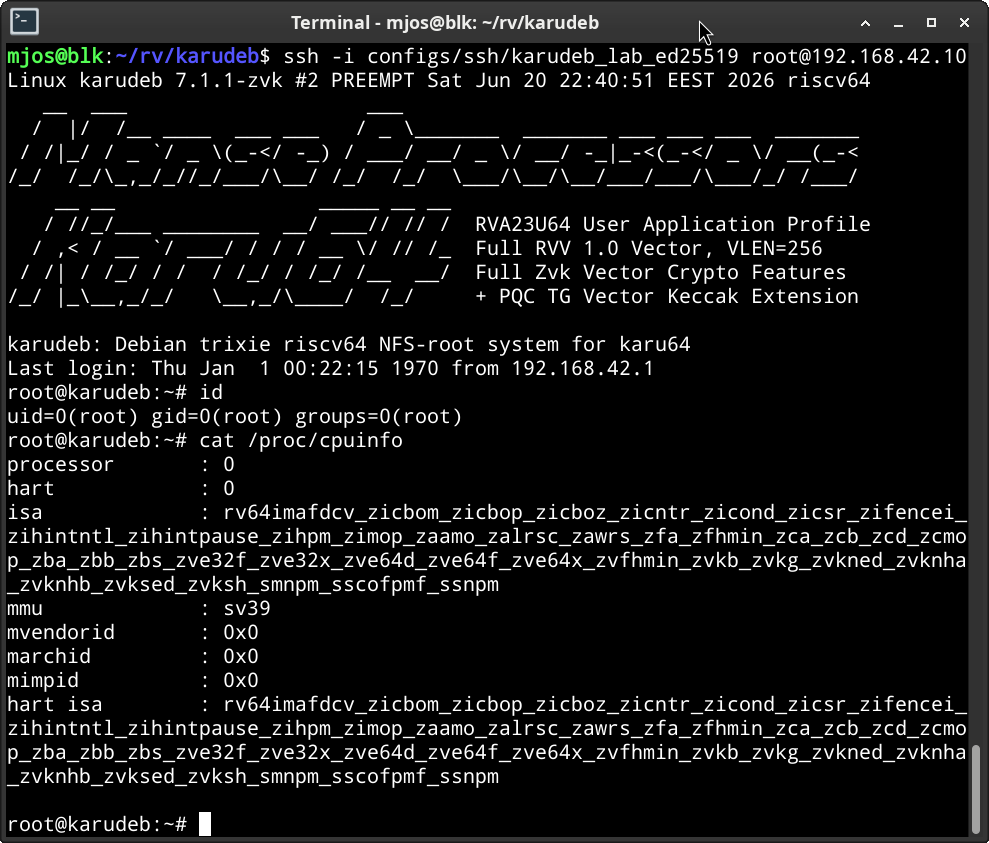
karu64 is a new RV64 Application core, with a focus on supporting the RVA23U64 application profile as well as the latest Cryptography extensions from RISC-V International. We implemented Karu CPU in portable Verilog, and it is released under a permissive (BSD 3-Clause) license.
The Linux baseline is RV64GCV (RV64IMAFDCV + Zicsr + Zifencei, RVV 1.0 with Zvl256b), with M/S/U privilege, Sv39 translation, generic CLINT/PLIC/NS16550 platform services (interrupts and serial console). We also have full Zvk (vector cryptography) extensions and Keccak available.
Today, we’re opening up two GitHub repos that together take a RISC-V core from RTL all the way to a Debian shell prompt.
- karu64 is a RVA23U64 - compliant RISC-V Vector core and FPGA bring-up tree — a single-issue, in-order RV64IMAFDC design with M/S/U privilege, Sv39 translation, IEEE 754 single- and double-precision floating point, and vector plus vector-crypto (Zvk) execution, targeting a VCU118 DDR4 SoC.
- karudeb is the Debian
riscv64NFS-root distribution scaffolding that builds the kernels, device trees, and root filesystems which boot Linux on that core, on real VCU118 hardware and under QEMU.
These two repos allow you to boot and SSH into the RISC-V system running on the VCU118 UltraScale+ board running at 75 MHz. The board has 2GB of DDR4 memory, accessible from Linux. There is no mass storage — files (including boot images) are served from the connected host over NFS over the local Ethernet connection.