TL;DR: Karu64 gains three opt-in features: the standard Zkr entropy source (seed CSR) backed by sampled ring oscillators, a RISC-V Debug 1.0 debug module reachable through the FPGA’s own JTAG port, and debug authentication. On 2026-11-18 the combined image passed its first board session on the VCU118, booting KaruDeb’s Linux 7.4-rc3 kernel, which picks up Zkr on its own.
Table of contents
Open Table of contents
Zkr: the Entropy Source Extension
Zkr is the entropy source part of the ratified RISC-V Scalar Cryptography extensions. It defines one CSR, seed (0x015). Each read returns a status, OPST, in bits 31:30, and in state ES16 also 16 bits of entropy. The other states are BIST (start-up test running), WAIT (no entropy available yet) and DEAD (failed). Accessing seed requires a CSR instruction that performs a write, normally csrrw. A successful poll consumes the returned word. M-mode always has access. S-mode and U-mode get access only if M-mode sets mseccfg.SSEED or USEED.
Zkr is deliberately an entropy source, not a random-number generator: its output is meant to seed a software DRBG, such as the Linux random pool.
A ring-oscillator noise source
On the FPGA, Karu64’s noise source is four free-running inverter rings of 3, 5, 7 and 9 stages, each sampled by a flip-flop on the 75 MHz system clock. Every inverter is placed by hand, and each ring has its own slices. One sample of the four rings is a raw 4-bit symbol, taken every 256 clocks.
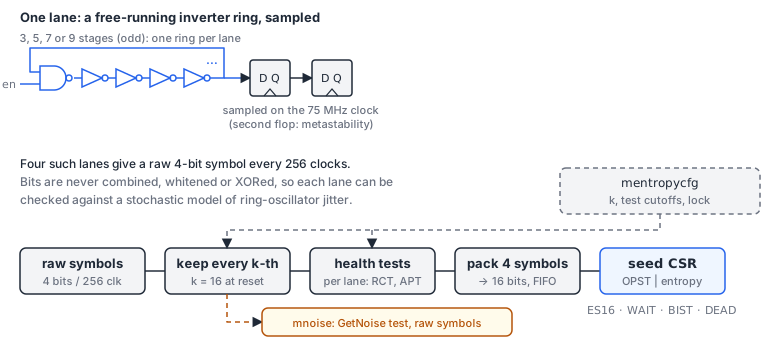
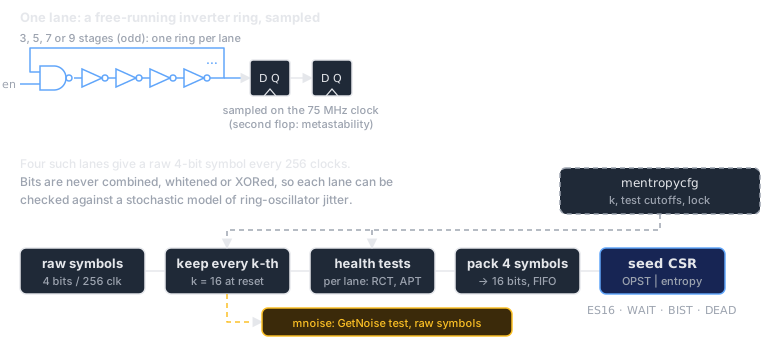
seed word.
Bits are never combined or whitened in hardware. That is a deliberate choice: each lane remains one physical process of the kind modelled in On Entropy and Bit Patterns of Ring Oscillator Jitter, with a frequency, a duty cycle and a jitter variance per sample. So each lane can be measured and checked against that model, instead of being hidden behind a conditioner. Two custom M-mode CSRs support this:
mnoise(0x7C8) is the GetNoise test interface suggested in the Zkr rationale. It returns raw symbols, with a flag for lost samples.mentropycfg(0x7C9) sets the decimation and the health-test cutoffs, and can be locked until reset.
How OpenSBI and Linux pick it up
Zkr is advertised like any other ISA extension: as zkr in the device tree’s riscv,isa-extensions. OpenSBI v1.9 reads it and sets mseccfg.SSEED, so that the kernel may use seed. Linux lists the extension, and its archrandom code then reads seed at early boot and at every reseed of the random pool. From the board’s console and /proc/cpuinfo on 2026-11-18 (long lines shortened):
OpenSBI v1.9
Platform Reboot Device      : syscon-reboot
Boot HART ISA Extensions    : smstateen,…,zihpm,zkr,smcntrpmf,…,v,f,d
…
Linux version 7.4.0-rc3-zvk-dirty …
Kernel command line: … random.trust_cpu=off
…
random: crng init done

root@karudeb:~# grep -m1 isa /proc/cpuinfo
isa		: rv64imafdcbvh_zicbom_…_zba_zbb_zbs_zkr_zkt_zvbb_…_svpbmt
The kernel command line has random.trust_cpu=off. Linux still mixes what seed delivers into its pool, but does not count it as entropy until the source has been characterised.
The first raw captures on the board, 10^6 symbols at each of six decimations, show what is expected and nothing more:
- each ring has a small fixed bias (its ones fraction is 0.485 to 0.498);
- the health tests stay far from their cutoffs;
- no dependence between lanes was detected.
At one sample per 256 clocks, successive samples are largely decorrelated. Two lanes still show small lag-1 autocorrelation at k = 1, but the captures do not provide enough information to fit the jitter model. The next step is a burst-capture mode that samples every clock cycle, for a proper characterisation.
RISC-V Debug 1.0
karudbg is a Debug Module that targets the ratified RISC-V Debug Specification 1.0, for a single hart:
- execution-based debugging through a debug ROM and an eight-word Program Buffer;
- optional abstract-command autoexec;
- two
mcontrol6address triggers, for hardware breakpoints and watchpoints, including restart of vector loads and stores; - System Bus Access, to physical memory and devices.
On the VCU118 the debug transport goes through the FPGA’s own JTAG port, a nested TAP behind the USER4 instruction. So an unmodified OpenOCD and GDB work over the board’s standard USB-JTAG cable, with no extra pins. Debug is opt-in: a build without it is unchanged, and the full debug configuration adds 0.81 % to the core’s NanGate45 area.
On the board, the debugger phases cover:
- run control and single-stepping in every privilege mode, M, S, U, VS and VU;
- the complete FP and vector register state;
- hardware breakpoints and watchpoints;
- SBA while the hart runs;
- a ten-minute soak;
- a breakpoint in the running Linux kernel.
After the debugger detaches, Linux boots and passes the usual acceptance tests.
Debug authentication
Unrestricted JTAG access is full machine-mode control of the hart. Debug 1.0 provides the hooks for authentication (dmstatus.authenticated, authbusy and the authdata register) but leaves the protocol to the implementation. Karu’s mechanism:
- Lifecycle. A part is
OPEN,AUTHorDISABLED. While locked, the Debug Module shows nothing but its version and theauthdatamailbox, and ignores every other write. - Island ROM. At power-on the hart starts in a small authentication ROM. On request, it runs one challenge–response exchange with the debugger.
- Nonce. The challenge carries a fresh 256-bit nonce read from
seed. - One window per power-on. If the debugger does not answer correctly within the window, the part boots on, locked. A software reboot does not reopen the window, and does not take away a grant.
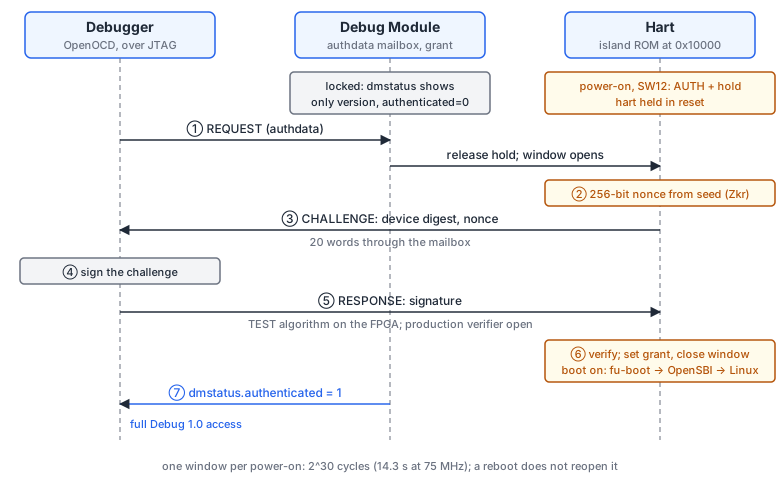
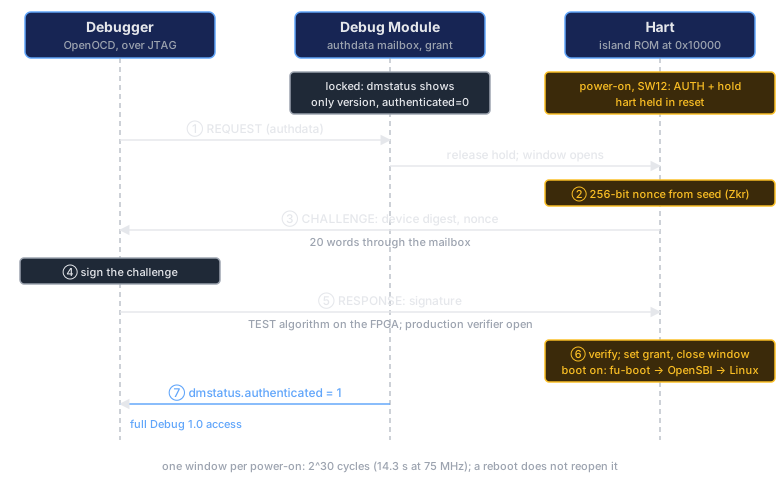
AUTH. The window opens once per power-on and lasts 230 cycles; the nonce comes from the Zkr entropy source.
The FPGA version is not secure, by design. It is a functional rehearsal of the mechanism intended for an ASIC:
- the ROM verifies a simulation-only
TEST“signature” whose key is public; - the lifecycle sits on DIP switches that anyone can flip;
- the entropy source is not yet characterised.
The production signature algorithm is still to be chosen; probably SLH-DSA and/or ML-DSA. On the FPGA, four DIP switches (SW12) select what an ASIC would fix in its lifecycle fuses and straps. They are read at the CPU reset button or at reconfiguration:
| SW12 | Off | On |
|---|---|---|
| 1 | lifecycle OPEN: debug without authentication | lifecycle AUTH |
| 2 | — | lifecycle DISABLED: no debug at all |
| 3 | boot normally | in AUTH: hold the hart until a debugger sends a request |
| 4 | entropy source on | entropy source off: seed stays in BIST |
All off is the default: the board then behaves like an image without these features. On the board, every case passed:
- authenticate, with a fresh nonce each time;
- wrong signature, replayed response and expiry, each left the part locked;
- no hold, disabled, and the entropy source off;
- a grant, and a locked state, each survived a software reboot.
KaruDeb: Linux 7.4-rc3 and OpenSBI v1.9
KaruDeb moves to Linux 7.4-rc3, built with Clang 24. With it, the Debian userspace passes the board acceptance:
- memory, cache and vector checks;
- the kernel’s AES self-tests on the vector crypto extensions;
- the vector ptrace selftests;
- the KVM tests.
The boot ROM now carries OpenSBI v1.9 with a syscon-reboot device, so reboot works without a debugger. The board went through eight software reboots in this session, each back through the boot ROM. KaruDeb also builds a zkr variant of the device tree, which is the one that turns Zkr on for Linux.
More information
- Zkr and the entropy source: FPGA guide,
rtl/karu_entropy.v,karu_rosc_rng.vand the follow-up plan. - Debug: the karudbg README and area and timing measurements.
- Debug authentication: the plan and the contract.
- The board acceptance record of 2026-11-18.
- KaruDeb’s Linux 7.4-rc3 kernel acceptance record.